Faces of Death (2026) | Review
There’s a certain breed of horror movie that arrives pre-loaded with its own thesis statement, like a term paper that also wants to make you vomit. Wes Craven was doing it in 1972 with The Last House on the Left. Michael Haneke refined the form into something almost unbearably precise with Funny Games in 1997. Now Daniel Goldhaber takes his shot, resurrecting the most legendarily disreputable title in the mondo horror canon and asking, with genuine intellectual audacity, what exactly has changed since 1978.
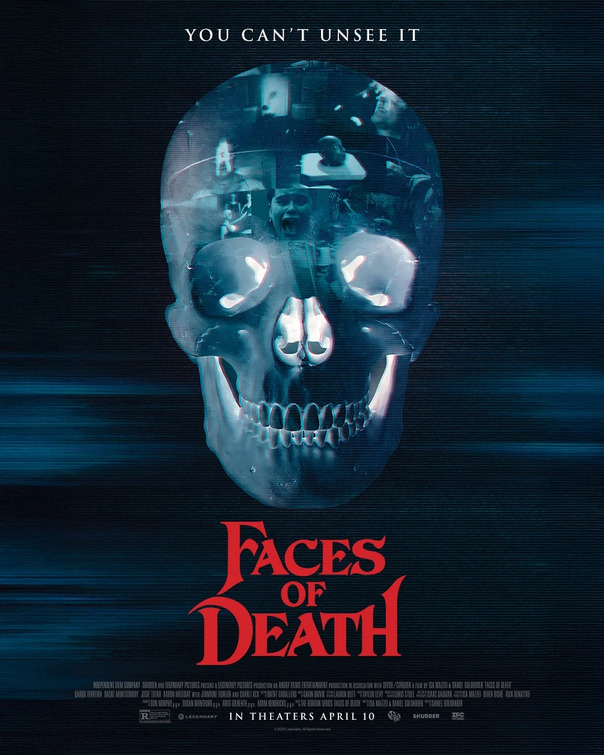
The answer, it turns out, is everything and nothing.
The original Faces of Death was a con. A cheap, profitable, genuinely repellent con—a faux-documentary narrated by a fake pathologist named “Dr. Francis B. Gröss” (you really have to admire that commitment to nominative determinism) in which staged executions were dressed up in nonfiction drag and sold to an audience desperate to believe they were witnessing the real thing. It was allegedly banned in 46 countries— a marketing claim so aggressively exaggerated it should have its own Wikipedia page under “Audacious Lies That Worked.” It became a VHS-era legend, a cursed object tucked behind the beaded curtains at video stores, right next to the stuff your parents definitely weren’t renting.
Goldhaber’s reimagining retains the title and the mythology while junking the fake-documentary format entirely. What he’s built instead is a razor-sharp meta-slasher that uses its grindhouse namesake as a haunted handmirror held up to the social media economy, and the reflection is not flattering to any of us.
Our entry point is Margot (Barbie Ferreira, doing career-best work), a content moderator at Kino, a TikTok-adjacent platform whose terms of service read like they were written by a liability lawyer having a dissociative episode. Sexual content? Gone immediately. Actual footage of a man having his skull caved in with a hammer and his brains subsequently eaten by the perpetrator? Well, that depends. Can you prove it’s real? The bureaucratic horror of Margot’s job, which consists of sitting in a fluorescent-lit cubicle, scrolling past the worst things humans do to each other, making judgment calls that a philosophy department couldn’t resolve in a semester, is where the film lands its sharpest punches. Goldhaber lingers on the gore here not for shock value but for something more uncomfortable: familiarity. The electrocution footage looks like things you’ve accidentally seen online. The hammer sequence is staged with a grimy, low-res authenticity that makes your stomach do things it shouldn’t. The point isn’t to disgust you and move on. It’s to make you uncomfortably aware that you’re making the same calculation Margot is—real or fake?—and that you’ve gotten very, very practiced at making it quickly.
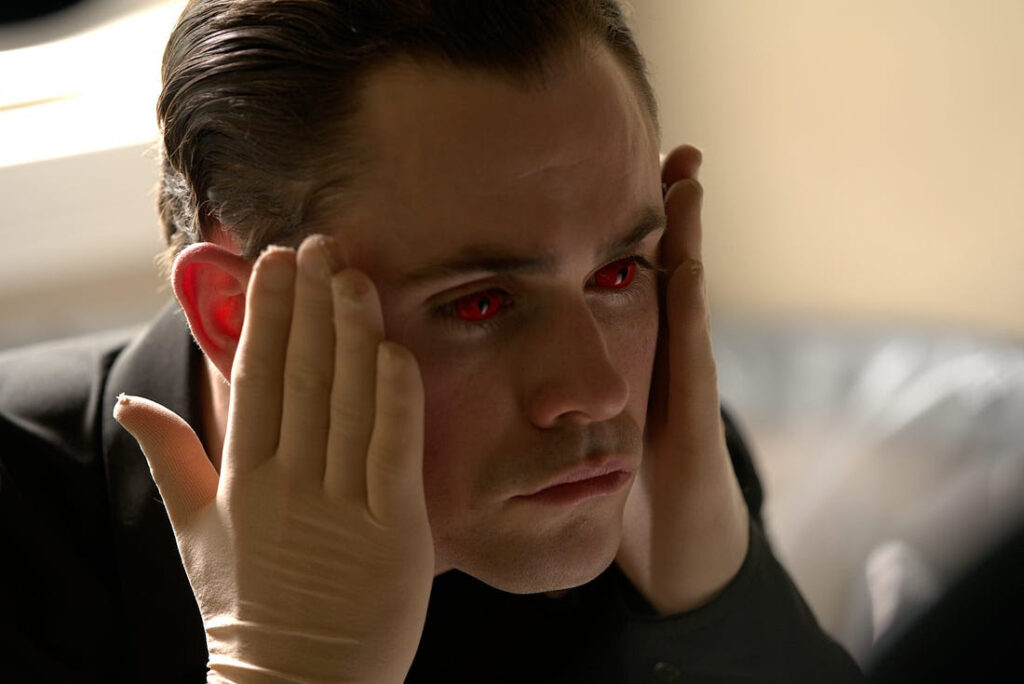
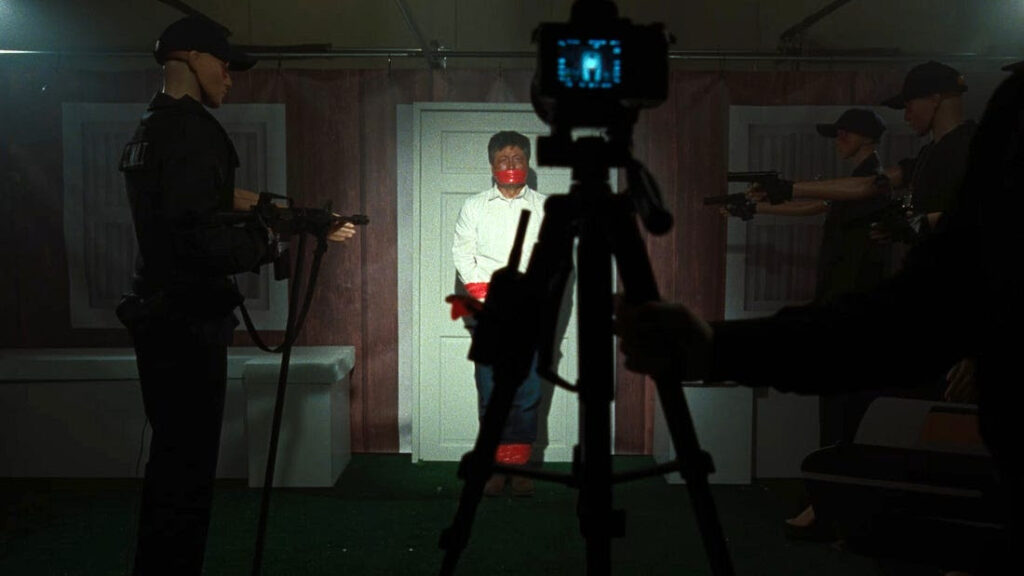
Meanwhile, in a cookie-cutter Florida McMansion that feels like the set of a real estate crime documentary, Arthur (Dacre Montgomery, all surface charm and sub-surface rot) is methodically kidnapping minor-league influencers and staging their deaths as elaborate recreations of the 1978 film’s greatest hits. He’s got them in cages in the basement. He’s got camera angles worked out. He’s got analytics. The modern serial killer optimizes.
The gore in these sequences is sparing but surgical. Goldhaber and co-writer Isa Mazzei (whose background as a former camgirl gives the film’s interrogation of performed identity an authenticity no amount of research could replicate) know that the most unsettling violence isn’t always the most graphic. It’s the violence that looks produced. Arthur’s snuff films have production value. They have pacing. That deliberateness is somehow worse than anything the splatter merchants of the ’80s ever cooked up, because it implicates an audience rather than simply assaulting one.
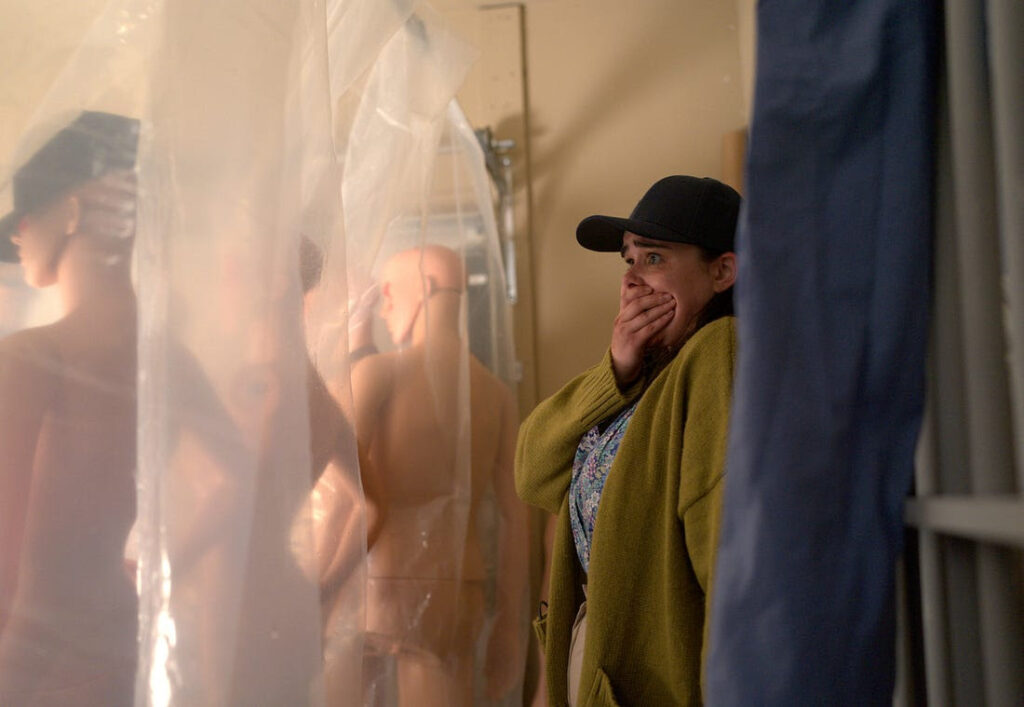
Ferreira carries the film through its occasional third-act wobbles (including a stretch that asks us to believe the entire internet recognizes Margot on sight) which even the most charitable viewer will find a reach. But she grounds every scene in something real: the specific, unglamorous exhaustion of a young woman who has watched too much and felt too little, trying to locate the line between the two.
Faces of Death understands something the original never could have: the truly forbidden thing right now isn’t content that feels real. It’s the dawning suspicion that nothing does anymore… and that we’ve quietly decided we prefer it that way.
The feed must be fed. We are all content moderators now. Most of us just don’t get paid for it.

